
天狼星
How can enterprises embrace AI transformation? ‘5A Framework’ unveiled_我的网站

A |
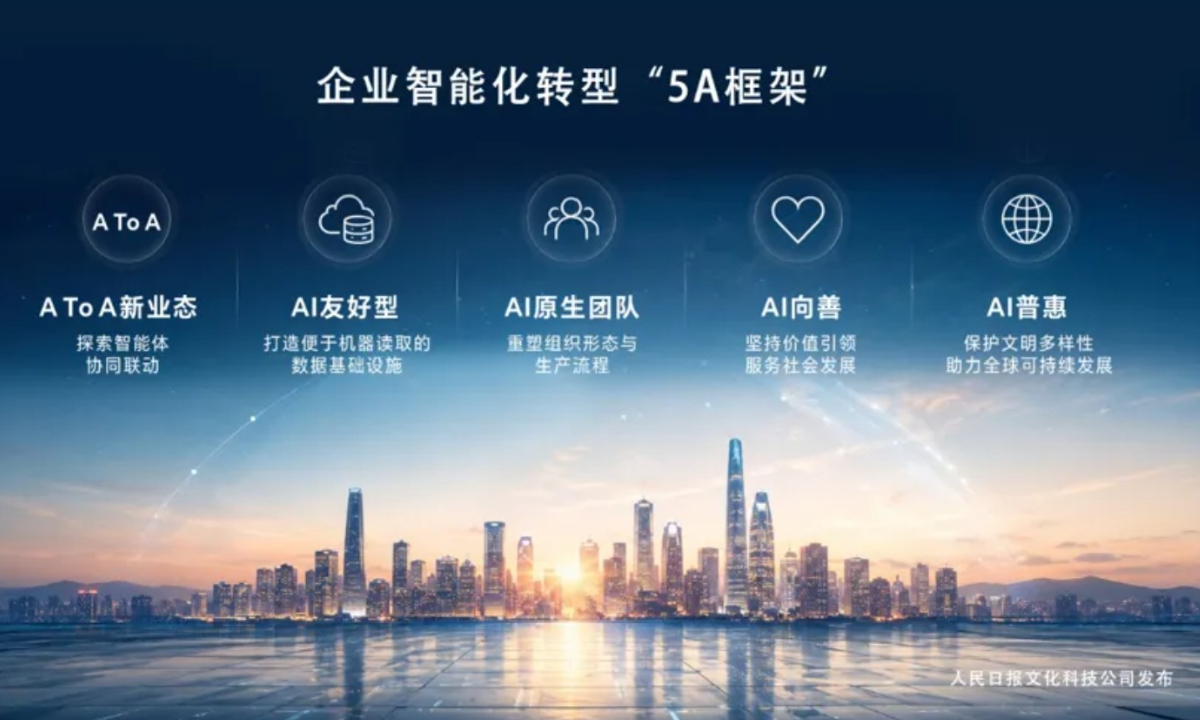
The 2026 Digital Intelligent Economy Forum was held in Langfang, North China’s Hebei Province, on Wednesday. At the forum, organizer People's Daily Cultural Technology Corporation unveiled a “5A Framework” for enterprise intelligent transformation, aimed at helping businesses comprehensively innovate their business models, organizational structures and service systems in the artificial intelligence (AI) era.
A To A: Exploring new models for agent collaboration
AI is pushing the internet into a new stage characterized by the widespread participation of AI agents. In the future, China could develop an ecosystem comprising tens of billions of agent applications, while the global “digital population” could reach hundreds of billions. Following To B (business-oriented) and To C (consumer-oriented) models, enterprises and institutions should actively explore the emerging To A (agent-oriented) model. To enable better interaction and coordination among agents, unified data, technology, interface and service standards need to be established, while new business systems and service models should be cultivated.
AI-friendly: Building machine-readable data infrastructure
Today’s internet user interfaces are primarily designed for human browsing. The first step, therefore, should be to build an “AI-friendly” data system that is better suited to being read, understood and accessed by AI. By structuring content resources and turning them into organized knowledge, while strengthening ontology systems and knowledge graphs, such a system can improve AI’s ability to understand and apply information. On this basis, integrated hardware and software infrastructure combining computing architecture with data systems can be developed for AI applications.
AI-native teams: Reshaping organizations and workflows
AI is profoundly reshaping organizational structures and ways of working. AI-native teams should redefine job responsibilities, organizational structures and business processes around the A-To-A model and AI-friendly services, enabling “everyone to have multiple AI agents.” Professional capabilities and business experience can be encapsulated into “digital employees,” promoting autonomous learning by agents, multi-agent collaboration and the evolution of collective intelligence, thereby multiplying per-capita productivity.
AI for good: Putting values first, serving social development
AI also requires values-based guidance. Guided by the principle of “being people-centered and using AI for good,” efforts should follow the approach of “governing AI with AI and guiding intelligence with wisdom,” ensuring that AI always serves social development, the public interest and people’s needs. The “Mainstream Values Corpus,” whose development was launched by the People’s Daily in May 2023, has already begun to take shape and has been validated through numerous large-model applications.
Inclusive AI: Protecting cultural diversity, advancing global sustainable development
AI should not become merely “a game for rich countries and rich people,” but should benefit all countries. Efforts should be made to actively participate in global initiatives for inclusive AI, bridge the digital and intelligent divide, and enable more organizations and individuals to share the benefits of development on an equal footing, so that AI can truly become a powerful positive force for improving the well-being of all humanity and advancing human civilization.
This was translated and compiled by the Global Times, based on an article originally published on people.cn on August 12, 2026.
。 [사진 뮤즈엠] 글로벌 아티스트 IP 기업 뮤즈엠(대표 박수왕·김현호·김상엽)이 중소벤처기업부와 중소기업기술정보진흥원(TIPA)의 2026년 ‘글로벌 팁스(Global TIPS) R&D’ 과제에 최종 선정됐다. 뮤즈엠은 이번 과제를 통해 50억원 규모의 정부 연구개발(R&D) 자금을 지원받아 ‘RF 멀티센서 기반 실시간 인파 안전관리 및 사고 예측 AI 시스템’을 개발한다. 글로벌 팁스 운영사 캡스톤파트너스의 투자와 추천을 통해 과제에 참여했다. 개발 시스템은 공연장에 설치된 RF(전파) 멀티센서를 활용해 관객의 이동과 밀집도를 실시간으로 파악하고 수집된 데이터를 AI로 분석해 혼잡 위험이 예상되는 구역과 시간대를 예측하는 기술이다. 이를 통해 카메라 영상이나 개인식별정보 수집 없이 인파 움직임을 분석하고 현장 운영자의 관객 동선 조정과 안전 인력 배치를 지원한다. 박수왕 뮤즈엠 CD(왼쪽)와 왕문주 NHN링크 대표. [사진 뮤즈엠] 뮤즈엠은 RF 센싱 및 AI·플랫폼 분야 전문기업들과 컨소시엄을 구성해 기술 개발과 실증을 진행한다. 국내 공연장과 전시장에서 검증한 뒤 K-팝 월드투어가 열리는 해외 대형 공연장과 글로벌 페스티벌 등으로 적용 범위를 확대할 계획이다. 뮤즈엠은 작년 아스트로의 단독 콘서트 ‘The 4th ASTROAD [Stargraphy]’의 인천 인스파이어 아레나와 일본 후쿠오카 페이페이돔 공연을 주관하는 등 대형 공연 운영을 진행해 왔다. 올해 4월에는 티켓링크 운영사 NHN링크와 글로벌 K-팝 공연 프로젝트 추진을 위한 전략적 파트너십도 체결했다. 김현호 뮤즈엠 대표는 “대형 K-팝 공연 현장에서 축적한 운영 경험을 기술 개발에 접목할 것”이라며 “국내 실증을 거쳐 해외 공연장과 페스티벌까지 적용 범위를 확대해 나갈 계획”이라고 말했다.。
Current article:http://gal2pw4.pisezuibanzoukou.cyou/r14x6/5qkhqg.html
Published on:14:59:34
我的网站相关内容
 1-7月份内蒙古自治区经济保持平稳、向新向优向好发展态势
 17 Guizhou schools partner with Malaysian counterparts
 【ソフトバンク】小久保監督「台湾は連れていかない」 柳田悠岐の復帰最短は3・3のOP戦
 五菱缤果S申报信息曝光 定位纯电小型SUV 比亚迪元UP同级
 霍尔木兹海峡通航前景不明 国际油价10日上涨约5%
 限量151台/直六+四驱 宝马540i xDrive Legacy Edition官图发布
- ·高键会见省消防救援总队政治委员王星一行
- ·上半年亏损或四千万,爱丽家居凭什么13天12板?,上半年亏损或四千万,爱丽家居凭什么13天12板?
- ·世界女排联赛:巴西队率先闯入四强
- ·"Only Followed Dharam Ji in My Career"- Salman Khan Breaks Down Remembering Dharmendra
- ·美国人忧心忡忡:004预计明年下水,11万吨搭载歼-50成全球最强?,兵器志,原创 美国人忧心忡忡:004预计明年下水,11万吨搭载歼-50成全球最强?
- ·记者:巴萨今夏难以引进B席,球员也没有将沙特视为优先选择
- ·载有伊朗总统莱希的直升机“发生硬着陆事故”
- ·黑色麂皮内饰/续航451公里 上汽大众ID.3 GTX套件款6月14日上市
我的网站最新内容
- ·贝索斯离婚,世界上最富有的王位或所有权的改变
- ·拓竹科技回应2027年IPO传闻:消息不实
- ·新加坡总理:学中文真的很重要!新加坡华文课程要有新变化了
- ·从“拼规模”到“拼价值”:中国汽车产业重塑增长逻辑,从“拼规模”到“拼价值”:中国汽车产业重塑增长逻辑
- ·巴沙土联盟邀请德黑兰加入,美以要是再打伊朗,那就是超级大战?,兵器海陆空,原创 巴沙土联盟邀请德黑兰加入,美以要是再打伊朗,那就是超级大战?
- ·7月中国全社会用电量再创新高 专家析拉动因素,7月中国全社会用电量再创新高 专家析拉动因素
- ·锁定万亿订单就能躺赚?这可能是AI产业链条上最大的“伪命题”!
- ·Emilia Clarke Admits to Missing 'Quite a Bit' of Her Brain After Suffering Two Aneurysms
- ·神都风物 | 文峰塔:藏在文昌风铃声里的洛阳文脉
- ·Bespoke tailor experiences top foreign tourists’ Shanghai travel list
- ·「2代目です」「ずっと残して欲しい」アニエスベーの“ショルダーバッグ”が大人気 「軽くて大容量」「カジュアルでもキレイめでも合います」
- ·不对劲!凌晨上海两车轻微碰擦,被撞的奔驰车主竟赔对方13万元?背后藏着一起刑事案件
- ·A股收评:超4200只个股飘红,沪指收涨,深指、创业板指收跌,A股收评:超4200只个股飘红,沪指收涨,深指、创业板指收跌
- ·Samantha Ruth Prabhu describes 2025 as ‘a year of gratitude’
- ·AI创意视频|新式彩礼
- ·Skip:我是首个叫威少威铁匠 他常年在三分垫底
我的网站热点内容
- ·奥克兰公交车又发生流血事件 6名青少年持刀袭击2少女
- ·名记:科尔希望库明加提升组织能力 做到快速阅读比赛&减少停球
- ·厦金“小三通”客运航线单日出入境旅客量创2023年复航以来新高
- ·美记:马瑟林要么先签后换赴鹈鹕 要么执行资质报价留守快船
- ·Aaj Ka Love Rashifal 27 August 2025: मेष राशि वाले जातक पार्टनर की बातों को जरूर सुनें, पढ़ें लव राशिफल
- ·黄陂00后小妹:刮中“多喜乐”百万大奖
- ·8月26日沧州永兴镀锌带钢价格动态
- ·台风“梅花”预计于14日登陆我国 国家防总提升防汛防台风应急响应至三级
- ·智慧笑联拖延退还校园热水账户余额,设置不合理退款期限
- ·张韶涵演唱会突发心脏不适 短暂休整后坚持完成演出
- ·海南产经新观察:商业航天加速起势,海南产经新观察:商业航天加速起势
- ·湖人底薪签约基奇,赞助商再送6000万?快船避税风波引爆联盟嘲讽!
- ·阿里巴巴股价跳空低开5%至69港元 再创上市以来新低
- ·通胀下的曙光?黄循财总理承诺努力应对高昂物价
- ·中原再担保集团股份有限公司董事长薛怀宇接受审查调查
- ·海港无名女尸案取得进展,警方收到近百个线索电话